Touring the city of Ramla
The name Ramla or Ramle (same place) does not immediately conjure up a place for tourism, but there is much of interest to see here over a half-day. The importance of Ramla relates to it being the capital of this district during the Muslim period. It was formed on sand and the name raml means sand in Arabic. Its importance also derives from the fact that it was located at the junction of the Via Maris, the main road connecting Cairo with Damascus, with a road connecting the Mediterranean port of Jaffa with Jerusalem.
Ramla was formed by Sulayman ibn Abd al-Malik, the son of Caliph Abd al-Malik of the Umayyad Caliphate, around 716 CE as an alternative to nearby Lod, which was previously the capital. It was the capital of Jund Filastin. A jund was a military district, and Ramla was a Muslim-created city in part of the province of Syria, which in turn was part of the larger Muslim empire. Ramla continued to be its capital throughout the Fatimad period.
The two Israel travel books that everyone was waiting for!
Bestseller! "In and Around Jerusalem for Everyone - The Best Walks, Hikes and Outdoor Pools" and new! "The North of Israel for Everyone. The Best Family Activities, Hikes and Historic Sites" by Arnold Slyper — with essays, directions, maps, and much more.
For courier service from Pomeranz Booksellers in Jerusalem (tel: 02-623 5559) click here and here. For Amazon click here and here. For details about the books and their outstanding reviews click here and here.
The Muslim period
Ummayad and Fatimad periods — what are we talking about?
Arab Muslim armies streamed out of Arabia in the 630s CE after the death of the prophet Muhammad, and took control of the Byzantine Empire, which was weakened by wars. A key figure was Caliph Umar ibn al-Khattab, often called Umar. In 638 CE, Jerusalem surrendered peacefully to him. According to tradition, Umar personally visited the city and allowed Christians to continue worshipping there, and Jews, who had often faced restrictions under Byzantine rule, were again allowed to live in Jerusalem.
Following struggles over succession, the next major rulers were the Umayyad Caliphate from 661 to 750. Their center was Damascus. An important caliph was Abd al-Malik. He built the Dome of the Rock around 691 CE on the Temple Mount in Jerusalem and it became one of Islam’s most famous shrines. His son Al-Walid I expanded the Al-Aqsa Mosque. Under the Umayyads, Arabic became the main language of the empire, and Islam gradually spread. The Umayyad founded the town of Ramla and this became the administrative capital of the area instead of Lod.
The Abbasid Caliphate replaced the Umayyads from 750 to 1099 and ruled from Baghdad rather than Damascus. During these centuries, trade connected the region to the wider Islamic world. Jerusalem remained important, but was no longer its political center.
The Fatimids were a Shiʿite Muslim dynasty based mainly in Cairo that ruled from 969–1171. They conquered the area from the Abbasids and made it part of an Egypt-centered empire. Jerusalem, Ramla, and the coastal cities became connected politically and economically to Cairo. They claimed descent from Fatimah, a daughter of Muhammad. An important and eccentric caliph was Al-Hakim bi-Amr Allah who obliterated the Church of the Holy Sepulchre in 1009. This event shocked Christians in Europe and became one of the factors leading to the Crusades.
In 1099, European Crusaders captured Jerusalem during the First Crusade and established Christian kingdoms in the region.
A well-known Muslim leader was Saladin, and in 1187, he defeated the Crusaders at the Battle of Hattin near the Sea of Galilee. He then recaptured Jerusalem. Saladin allowed many Christians to leave the city safely and again permitted Jewish settlement. He founded the Ayyubid dynasty, and Muslim control was restored over much of the region.
The Mamluks were originally slave soldiers who became rulers based in Cairo. They defeated the Crusader kingdom along the coast and the Mongols, and helped preserve Muslim control of the area. An important Mamluk ruler was Baybars who strengthened Muslim rule and rebuilt fortifications and roads. During the Mamluk period (1250–1517), Jerusalem became an important religious city again, and many schools, markets, fountains, and hostels were built. Much of the historic architecture seen today in Jerusalem’s Muslim Quarter dates from this era. The Mamluks also developed roads for pilgrims, caravan trade, and religious institutions.
In 1517, the Ottoman Empire conquered the region from the Mamluks. This began some 400 years of Ottoman rule.
Touring the city of Ramla:
It is suggested to park at the large free parking lot by the shuk, and from this parking lot you can walk to all the Ramla sites. Enter Shuk Ramla into Waze. There are restrooms at the edge of the parking lot. A brochure and map can be obtained at the Ramla Museum and a circular walking tour of Ramla is described. There is also a GPS application for smart phones available free of charge with a guided circular tour to all the town’s sites. Search for “Go Ramla” in the App store or on Google. The Pool of Arches and the White Tower are a longer walk and you may wish to go there by car. Other sites are close to the parking lot.

#1. The Ramla Museum
This small museum of six rooms is a good place to start your visit, since it has a nice introduction to the city and documents its history from its foundation in the 8th century to the present day. It is in a municipal building from the time of the British Mandate. The exhibits demonstrate everyday life, commerce and art, as well as the population’s multi-cultural ethnic fabric. Exhibits include gold coins and hidden treasures that were discovered in the town. A short movie is shown with English subtitles on the various tourist sites that can be seen.
The address of the museum is 112 Herzl St. It is open from 10.00 a.m. to 4.00 p.m. from Sunday to Thursday and 10.00 a.m. to 1.00 p.m. on Friday. Admission is 20 nis for adults and 15 nis for children and seniors. A combined ticket for the different sites is available. This is their phone number 08-929-2650. This is their website

The multi-cultural make up of the city of Ramla

Exhibit of the treasure of gold coins discovered in the city
Ramla’s Market (the shuk)
This market dates from towards the end of the Ottoman period. It sells a variety of foods and goods at reasonable prices and is a popular destination. On Wednesday the market expands into a grand bazar beyond the permanent market. Food specialties of the shuk include Ramla Burekas and the Tunisian sandwich.
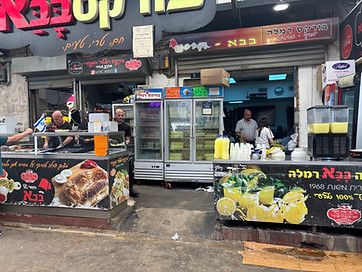

#3. The Great Mosque of Ramla
Many mosques are not open to non-Muslims. This one is and it therefore provides an opportunity to view the inside of a mosque. Plus, this is an unusual mosque, in that it was formerly a Crusader church. One therefore sees the inside of both a mosque and a church!
It was turned into a mosque in the middle of the 13th century in the Mamluke period. It is one of the few buildings to have completely survived from the time of the Crusaders.
The features of the church are its basilica structure with a central aisle, two lateral naves, and the apse of the original church on the eastern wall. It was called the Church of St. Samuel because the Crusaders believed that Samuel might have been born here in Ramla because of its similar name to Ramah. A similar story was told about Nebi Samuel in Jerusalem.
When it was turned into a mosque a muezzin was added to call congregants to pray. A prayer niche or mihrab was also added to the southern wall facing towards Mecca and a minbar for sermons was also placed on this wall. On the doorframe are two Arabic inscriptions. One was taken from the White Mosque and describes the conquest of Ramla by Baybars and the other the transformation of this church into a mosque in the 13th century.
The address of the mosque is Sderot Shlomo Hamelech 10. It is open from Sunday to Thursday from 8.00 a.m.to 10.00 a.m. and on Saturday for groups with prior arrangement. Admission is 7 nis. For reservations call 08-922 5081.

This mosque is in a basilica-style with its "apse" facing to the east

Its mihrab faces to the south towards Mecca and its minbar is also on the southern wall
#12. The Pool of Arches
The Pool of Arches is probably the most popular tourist site in Ramla and is a fun place for children and adults. This underground pool is at the bottom of steps and the pool is explored in a small paddle boat.
This is a large cistern that was completed in the Abbasid period in 789 CE by Al-Rashid. He ruled from Baghdad during the peak of the Islamic golden period. It was this Caliph who inspired the tales of the famous Arabian nights.
Most of the arches are original while others are reconstructed. The arches are pointed, which is often regarded as a Crusader feature, but pointed arches were built before this. There is an inscription by an arch at the entrance and its Islamic date allows us to date the construction of the pool: “In the name of Allah and with Allah’s blessing, the agent of the Emir of the faithful ordered construction, may Allah lengthen his days, in the month of Haja in the year one hundred and seventy two.”
There is an aquifer beneath the city, but it is deep and the water is not tasty, being mildly saline. Water was therefore brought from the bottom of Tel Gezer via an aqueduct to nine cisterns within the city, and this was one of them. The aqueduct was only operative for 150 years, and the pools subsequently dried out.
Enter “Pool of the Arches” into Waze and Moovit. There is street parking. The site is open Sunday to Thursday 8:00 a.m. to 16:00 p.m., Friday and holiday eves 8:00 am to 14:00 pm, and Saturday and holidays 8:00 a.m. to 16:00 p.m. Admission is 25 nis for adults and 21 nis for children and seniors. Their phone number is 08-921 6873. The site has shaded picnic benches. This is a website:


Picnic area in the Pool of Arches
#11. The White Tower
The White Tower is not white, but was probably named this because of its proximity to the White Mosque. This is now in ruins but may have been covered by white marble. The tower is 30 meters tall, and you can climb the somewhat deep 111 stone steps to the top, from where there is a panoramic view of the coast and Judean Mountains and Samaria.
It is located in what was once the center of ancient Ramla and was built and completed by the Mamluk sultan Muhammad Ibn Khalhoun in 1318.
It functioned as a watchtower and may also have been used as a muezzin that calls the Muslim faithful to prayer five times a day. In the ground between the square tower and the remnants of the White Mosque are three subterranean water reservoirs. These are no longer connected to the aqueduct and are now dry.
There is a legend that reflects the rivalry between Lod and Ramla and tells us that the people of Lod (Lydia) were jealous of their neighbors in Ramla because of this square tower and decided to steal it and put it up in their own town. During the night, the young men from Lod tied ropes from rubber around the tower which they had received from an old Sheikh who had decided to make fun of them. He told them not to look backwards or the tower would return to its place. They began pulling in the direction of Lod. As they neared their town, they started calling joyfully, “The tower of Ramla is coming closer.” The people of Lod heard this and came out happily to welcome the tower. They pointed out, however, that the tower looked as if was still in in its place in Ramla. When they looked back the tower was indeed still in its place.
Directions: Enter “White Tower” into Waze or Moovit and click on “What Tower Ramla.” There is a large free car park by the tower. Walk along Dani Mas to the main entrance under an arch. Admission is 17 nis for adults and 15 nis for seniors and children. A combined ticket for the different sites is available. The tower is open from 8.00 a.m. to 4.00 p.m. Sunday to Thursday, Saturday and holiday 8.00 a.m. to 4.00 p.m., and Friday and holiday eves 8.00 a.m. to 2.00 p.m.

The Universal Karaite Judaism Center
This is the world center for Karaite Judaism. Karaite Judaism emerged during the Abbasid Islamic period in the 8th to 9th centuries CE, when Jewish intellectual life was flourishing in places like Iraq, Persia, and Palestine.
The movement is traditionally linked to Anan ben David, although modern historians think Karaite Judaism evolved from several anti-rabbinic trends rather than from one founder alone.
The defining belief of Karaites is that only the written Hebrew Bible (Tanakh) is divinely authoritative, while the Oral Torah, later codified in the Mishnah and Talmud, is from human tradition rather than binding revelation. Hence, Karaites argue that every Jew should study Scripture directly rather than relying on rabbinic tradition. This put Karaites in sharp disagreement with what became mainstream Rabbinic Judaism.
Karaites became highly influential between the 9th and 11th centuries, and major Karaite centers existed in Jerusalem, Ramla, Egypt, Byzantium, and Crimea. When Maimonides arrived in Fustat (old Cairo) in Egypt in approximately 1168, this was a predominantly Karaite community. Over time, Rabbinic Judaism became dominant throughout the world and the Karaite communities declined.
It is estimated that there currently exists 25,000 to 50,000 Karaites, most of whom live in Israel. Smaller communities also exist in the United States, Turkey and Eastern Europe. In Israel, they are officially recognized as Jews, and they maintain their own religious courts and synagogues. They participate fully in Israeli society, including joining the Israeli army. Their communities remain particularly concentrated around Ramla and nearby central Israeli cities.
It is possible to visit their center in Ramla on Joseph Klausner Street and at a group visit learn about their way of life. At this time, one also views their synagogue. For coordination, call 08-924 9104 (ask for Shlomo, the director of the center).
If you are truly interested in learning about Karaite Judaism, the Karaite synagogue in the Old City in Jerusalem currently provides a more comprehensive tour. There is an informative movie, a lively discussion with a guide, a display of the essential features of Karaite Judaism, and a view of their synagogue.

There are no pews in Karaite synagogues, as the congregations engages in prostration as in biblical times.