The Bahai Gardens in Haifa
The Bahai Gardens
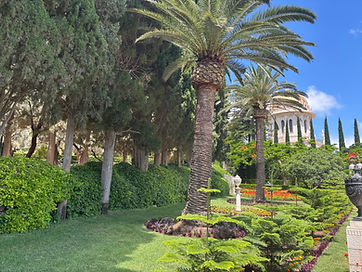
No tourist visit to Haifa is complete without a visit to the Bahá’í Gardens. These are a series of 19 stunning terraced gardens cascading down the northern slope of Mount Carmel centered around the golden-domed Shrine of the Báb. The gardens blend Persian, European, and Mediterranean styles to symbolize the Bahá’í vision of the oneness of humanity. The formal gardens along the terraces blend on either side with native trees and wildflowers. The site is both a sacred pilgrimage destination and a symbol of peace and beauty that is open to everyone without payment.
The two Israel travel books that everyone was waiting for!
Bestseller! "In and Around Jerusalem for Everyone - The Best Walks, Hikes and Outdoor Pools" and new! "The North of Israel for Everyone. The Best Family Activities, Hikes and Historic Sites" by Arnold Slyper — with essays, directions, maps, and much more.
For courier service from Pomeranz Booksellers in Jerusalem (tel: 02-623 5559) click here and here. For Amazon click here and here. For details about the books and their outstanding reviews click here and here.
The Bahá’í Gardens were built primarily as a spiritual and administrative center for the Bahá’í Faith and to honor the resting place of the Báb, one of the central figures of their religion. The nineteen terraces stretch for about kilometer up the mountain. The terraces were built in stages, although the current design surrounding the Shrine of the Báb was constructed between 1987 and 2001. The gardens overpass several roads. They were officially opened to the public in 2001.
The geometrically precise and symmetrical designs, which incorporates elements from different cultures, represent the core Bahá’í values of harmony, order, and universality. The use of many types of flora symbolizes the beauty of diversity, and the notion that all humanity is one garden with many unique plants.
The Báb’s remains were initially interred on Mount Carmel in 1909, fulfilling a directive by Bahá’u’lláh (the founder of the Bahá’í Faith). The Shrine of the Báb was completed in 1953, earlier than the gardens. The gardens are part of the Bahá’í World Centre, which includes administrative buildings such as the Universal House of Justice.
VIEWING THE GARDENS
There is a short balcony at 61 Yefe Nof St. from which the entire expanse of the Terrace can be viewed. This is a very short distance from where the Upper Terrace Tour starts.
This balcony is also adjoining the beginning of the Louis Promenade. This is a 400-meter scenic, tree-lined walkway perched on the slopes of Mount Carmel in Haifa. It is highly regarded for its spectacular, panoramic views of the Mediterranean Sea, Haifa Bay and the ports, the industrial area around the Kishon Stream, the Baha'i Gardens, Acco, and on clear days the white peaks of Mount Hermon.
The Terraces can be visited by reservation or walk-in tour. The Upper Terrance Tour starts at 45 Yefe Nof St. This can be easily reached by public transport (use Moovit), and if coming by car there may be parking on the street. The times and language of the tours (there are Hebrew and English tours) are available on line and should be booked in advance to be assured of a place. Click here for their website:
The outer gardens (this is not the complete Terraces) are open from 9 a.m. to 5 p.m. The entrance is on Terrace 1 (on Ben Gurion Avenue) and 80 Hatzionut Avenue.
The Shrine of the Báb and inner gardens are open daily from 9 a.m. to 12 p.m. The entrance is near the corner of Hatzionut Avenue and Shifra St. Parking may be limited here. The shrine consists of a simple room with the shrine area decorated with unlit candles and fresh flowers.
There is no charge for entrance to the gardens or for the tours. You are asked to wear clothing that covers your shoulders and reaches your knees, with no tears. There are lots of steps on the tours, but the railings help

The Gardens from the Promenade at 61 Yefe Nof St.
Tomb of the Baab

Looking up at the Bahai Gardens from the German Colony

The Bahai Gardens at night
THE BAHAI FAITH
The Bahai Faith is the most recent of the world’s religions, being formed in 1844. It may well be the world’s second-most widespread religion geographically with almost five to eight million adherents living in almost every country.
The story starts with the Báb, a young merchant in Persia, who proclaimed in 1844 that he was a divinely inspired figure and the "Gate" (Báb) to a new era, and that he was preparing the way for "He whom God shall make manifest." His charisma and wide appeal, especially among youth and scholars, worried the ruling elite and he was seen as destabilizing and potentially revolutionary. His message also directly challenged the authority of Shi’ite Islam which regarded Muhammad as the last of the prophets. His teachings challenged the religious and political authorities of Persia and he was publicly executed by a firing squad in 1850.
Bahá’u’lláh (1817–1892) is regarded as the founder of the Bahá’í faith. Born in Persia, he was a prominent follower of the Báb, and in 1863, while exiled in Baghdad, he publicly declared that he was the promised one foretold by the Báb. This event marks the beginning of the Bahá’í faith.
Bahá’u’lláh is considered by the Bahá’í to be the most recent in a line of divine messengers which includes Abraham, Krishna, Moses, Buddha, Jesus, Muhammad, and the Báb. He was imprisoned and exiled repeatedly by Persian and Ottoman authorities over a period of 40 years. He authored many sacred texts. His final place of exile was in Acco, where he was under house-arrest, and this is where he died and was buried.
The Bahá’í Faith has no clergy and its affairs are administered through a system of elected councils at the local, national and international levels. The Universal House of Justice in the Bahá’í Gardens functions as the religion’s governing body.
The Bahá’í Faith teaches that there is one God, the source of all creation, who is unknowable in essence but reveals Himself through His messengers. All major world religions come from the same divine source and are part of a single, progressive process of revelation. Figures like Moses, Buddha, Jesus, Muhammad, and Bahá’u’lláh are seen as Manifestations of God.
The religion teaches that all humans are equal, and the elimination of all forms of prejudice — racial, religious, national, etc., — is essential for global peace. All individuals must seek truth independently without blind imitation of traditions or clergy. True science and true religion must agree, since they are complementary means of understanding reality. Men and women are equal and should have equal opportunities and rights in all aspects of life. A peaceful and just world society should be established that includes global governance and collective security. Economic systems should be guided by spiritual principles such as justice, generosity, and moderation.
The remains of the Báb were secretly rescued by his followers and hidden for nearly 60 years. Under the instructions of Bahá'u'lláh and later Abdu'l-Bahá, the remains were clandestinely smuggled across the Middle East before finally arriving in Haifa in 1899.
Touring Haifa
The Clandestine Immigration and Naval Museum
Haifa Cable Car from Beit Galim Promenade
The Muhraqa Monastery (on Mount Carmel)
Gan Ha’em and Haifa Zoo (family park - not reviewed)