Discover the Old City of Acre
Acre (Acco in Hebrew) is accredited as a UNESCO World Heritage Site. Its Old City is very quaint, the harbor is picturesque, and its tourist sites are superbly presented. It is very easy to spend most of a day here. A convenient place to start your visit is the Visitors Center. They provide a free map, show a short movie about Acre, and from here you can buy a combined ticket to the multiple sites offered. They can also help you plan your visit to Acre. The Visitor Center is adjoining the Hall of Knights (Citadel), a site that should not be missed.
Every English-speaking visitor and resident of Israel should own my two books! Bestseller! "In and Around Jerusalem for Everyone - The Best Walks, Hikes and Outdoor Pools" and new! "The North of Israel for Everyone. The Best Family Activities, Hikes and Historic Sites" by Arnold Slyper — with essays, directions, maps, and much more.
For courier service from Pomeranz Booksellers in Jerusalem (tel: 02-623 5559) click here and here. For Amazon click here. For details about the books and their outstanding reviews click here and here.
Directions and parking: To begin your visit at the Visitors Center in the Enchanted Garden, enter into Waze “Knights Hall” and click on “Knights Hall, Old Akko.” There is free parking at Hafir (moat) Parking lot. Eucalyptus Parking lot is free Sunday to Thursday and has paid parking Friday and Saturday. Parking is 20 ILS for a full day at the Abirim Parking lot. There are also other parking areas in the city.
Admission:
Hours for the Crusader Hospitaller Quarter and Fortress and also the Visitors Center are Sunday to Thursday and Saturday 9:00 a.m. to 6.00 p.m., and Friday and holiday eves 9:00 a.m. to 4:00 p.m. Last entrance is 1 hour before closing. In winter, the site closes 1 hour earlier. Tickets for the sites can be purchased in advance, but this is not essential. There is an additional charge for a (necessary) audio guide. This is available in a number of languages. There are shaded picnic tables, a restaurant, and a stall that sells drinks.
A combined ticket includes entrance to many of the tourist sites and museums. These include the Knights Halls (the Hospitaller Fortress), the Turkish bath, the Templar tunnel, the Ramchal synagogue and new Jewish Heritage Center, the Okashi Museum of Modern Art, and the Ethnographic Museum ‘Treasures in the Wall’. The combined ticket does not include entry to the Al-Jazzar Mosque, the Museum of Underground Prisoners, and the Tunisian Synagogue and these all have separate charges. There is a short free movie in the Visitors Center about Acre that can be viewed in English. A free map of the Old City is available. This is helpful if you intend walking to other sites in the city. Their contact number is 04 995 6706/7. This is their website.

View of the port of Acco from the eastern wall
The history of Acre
The ancient city of Acre was formerly on a tel dating from the Middle Bronze Age. Its Canaanite name was Ak, and it had city walls and a gate. This tel is now located in the New City, and has not been excavated. It is mentioned in the Book of Joshua as being allocated to the tribe of Asher, but was never conquered by them (Judges 1:31). It ןs called Akko in the Bible. Under the Phoenicians and subsequently the Hellenistic and Roman powers it developed as an important Mediterranean port. Already in the Hellenistic period there was habitation below the tel, extending onto the valley and the plain towards the shore. The Greeks called this city Ptolemais, and this name remained in use during the Roman and Byzantine periods.
It was a Jewish and pagan city in the Byzantine period and there is mention of 15 sages living here. Its wall and harbor were renovated in the Muslim period. The city was lost to Saladin in 1187, but recaptured in 1191 during the Third Crusade.
It took the Crusaders three years to capture the city. The capital of the Kingdom of Jerusalem was Jerusalem, but its main port and trading center was Acre from 1104 to 1187. Its period of maximum growth was during this time. From the 12th to the end of the 13th century it was a cosmopolitan city, and there were merchants, soldiers and pilgrims from throughout Europe and the Mediterranean.
Maimonides briefly visited Acre during the First Crusader period in 1165, and was later buried in Tiberias. Benjamin of Tudela visited Acre around 1170 and reported approximately 200 Jews living here, including several prominent scholars. Nachmanides immigrated to Jerusalem in 1267 during the time of the Third Crusade and stayed in Acre for two years until his death in 1270. Also at this time, 300 Rabbis from Ashkenaz settled in Acre to form a Kollel or Jewish learning center. Among them were important Tosafist scholars. Around 1260, Rabbi Jehiel of Paris, together with his son and a large group of students, settled in Acre and established the Midrash ha-Gadol de-Paris (Great Academy of Paris), turning Acre into a major center of Talmudic learning.
The city was captured by the Mamluks in 1291, and they left it in ruins so that it could not be used again in any future Crusade, as was consistent with their policy along the coast. This brought the city’s Jewish golden age to an abrupt end. From then on until the Ottoman period, Acre remained no more than a small fishing village.
During the Ottoman period, the Bedouin chieftain Doher El-Omar took control of Acre from 1720 to 1750. He developed it as a new naval city and built walls around it. The extent of his city was equivalent to today’s Old City, although this was less extensive than the Crusader city. During this time Rabbi Chaim ibn Attar (known as the Ohr HaChaim HaKadosh), stayed temporarily in Acre before moving to Jerusalem, and Rabbi Chaim Luzzato came to live here. Doher El-Omar was followed by Ahmad Pasha al-Jazzar who further developed the city. He levelled the ground for his building projects by filling Crusader buildings completely with soil and building on top of them. Thus, there are intact Crusader projects beneath the pavements of the Old City.
A walk through the Old City of Acco:
-
Start at the Visitor Center, and make your way to the Crusader Hospitaller Quarter, the entrance of which is on the other side of the garden. Alternatively, to the Museum of Underground Prisoners, which is a very short walk from the Visitor Center through an arch on the same side of the complex as the Visitor Center — or visit both!
The Crusader Hospitaller Quarter is one of the most important sites in Acre and is a good place to start your visit. It has a number of other names including the Citadel, Akko Fortress and Knights' Halls - but they are all the same place. It will definitely engage your interest, especially via the colorful displays projected on the walls.
The marble fountain outside the famous All-Jazar Mosque
Directions and parking: Start your visit at the Visitors Center in the Enchanted Garden. Enter into Waze “Knights Hall” and click on “Knights Hall, Old Akko.” Free parking is available at Hafir (moat) Parking lot. Eucalyptus Parking lot is also free Sunday to Thursday, and has paid parking Friday and Saturday. Parking is 20 ILS for a full day at the Abirim Parking lot. There are also other parking areas in the city.
Admission: Hours for the Hospitaller Quarter and Fortress and Visitors Center are Sunday to Thursday and Saturday 9:00 a.m. to 6.00 p.m., and Friday and holiday eves 9:00 a.m. to 4:00 p.m. Last entrance is 1 hour before closing. In winter, the site closes 1 hour earlier. If you are not with a guided tour, an audio guide is helpful and is available in a number of languages.

The mens' restroom!
Why were the Hospitaller’s fortress and quarters so magnificent?
The Crusaders captured Acre during the First Crusade in 1104 CE under the command of King Baldwin I. Acre provided them a foothold into the country and it rapidly became the main Crusader stronghold for the Crusader Kingdom of Jerusalem, a Christian kingdom centered around Jerusalem. Other states formed by the Crusaders were the County of Edessa, the Principality of Antioch and the Country of Tripoli.
Because of its harbor, Acre became a crucial maritime hub for supplies from Europe. By 1170 it had become the main port of the Eastern Mediterranean and was providing the Kingdom of Jerusalem with considerable wealth, particularly from the Asiatic spice trade. However, the good times did not last. In 1187 the Ayyubid sultan Saladin decisively defeated the Crusaders at the Battle of Hattin at Karnei Hittin (see our webpage on Karnei Hittin). This was the end of the Kingdom of Jerusalem, since most of the Crusader knights were either killed or captured. Acre capitulated without a fight.
Acre remained in Muslim hands for only 4 years. It was captured in 1191 after a 2-year siege by King Richard I of England and King Philip II of France during a Third Crusade. (The Second Crusade (1147–1149) was a failed attempt to reclaim the County of Edessa). The Crusaders were unable to reestablish the Kingdom of Jerusalem, but they succeeded in establishing a powerful Crusader state along the coast extending from Tyre to Ashkelon, and which lasted for 100 years.
The Crusaders were volunteers who served in the Crusader army for only a limited period of time. A foreign kingdom in hostile territory could not be maintained by volunteers alone and a number of monastic military orders were established for its defense. Two of the most influential were the Knights Templar and the Knights Hospitaller. The Hospitallers cared for the sick and provided for the safety of pilgrims in the Holy Land. They also established fortresses throughout the kingdom to protect the pilgrims.
This fortress and fortified quarters of the Knights Hospitaller were revealed fortuitously when digging under the Ottoman pavements. The magnificence of their center is very apparent. It was a rich order in a thriving Crusader kingdom. The Hospitallers were especially active in growing sugar cane and in the sugar trade .
The Hospitallers moved from their original quarters to the place you are now visiting in the northwestern part of the city and adjacent to its then northern wall. Following the loss of Jerusalem and their main headquarters, the Hospitallers expanded their center in Acre to the street adjacent to the city wall. Their center consisted of two or three storied wings around a central courtyard. The upper stories no longer exist as they were destroyed by Muslim armies, but the ground levels have been revealed. The Hospitallers also built a church south of the compound named after St. John. This was one of the most magnificent and largest churches in the Crusader Kingdom.
The Hospitaller Quarter lasted for 100 years until the conquest of the city by the Muslim Mamluks in 1291 and they left the city desolate. In the main, Christian pilgrims to the Holy Land (who were still permitted) now arrived through the port of Jaffa
If you are not on a tour, pay for an audio guide. You can also take a map of the site from the desk and this shows the numbered sites and directions as to where the audio guide is directing you. It is possible to spend quite a bit of time here, and if your time is limited it is worthwhile timing yourself. For example, the first place you enter is the Prison Hall. This has signs with considerable information about the history of Acre during various historic periods. If your time is limited, you might wish to examine only the signs of interest to you and skip the others. Also, to shorten the halls you visit.
What you are looking at is the headquarters of the Knights Hospitaller. This was not simply "knights' quarters," but a complex that functioned as a monastery, military headquarters, hospital, administrative center, warehouse, and residences. Remember also that you are walking through streets and then into a courtyard, even though they now have a ceiling. There is artwork around to enable you to feel that you are actually walking during the Crusader period.
The refectory (dining hall) is particularly impressive because of its huge columns and Gothic vaulting. You will soon come to the magnificent central courtyard. Before it was uncovered, this was below the courtyard in the Ottoman prison above!
You can if you wish view the public Crusader Laterines. These emptied into a large cistern. These would have been naturally flushed away during the winter rains, and this would explain why this city may have been at times rather smelly. Enter the Great Hall with its Gothic architecture consisting of massive walls, vaulted ceilings, pointed Crusader arches, and wide columns. They were this size to support the several stories above the hall. These were destroyed when the street was levelled.

A street in the Hall of Knights
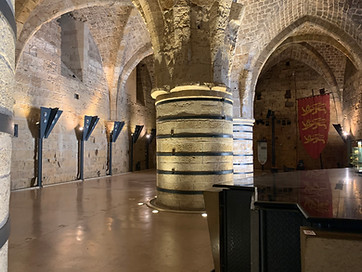
The Refrectory with its huge columns and Gothic vaulting

The central courtyard of the Hall of Knights was beneath the courtyard of the Underground Prison!
The Museum of Underground Prisoners
The Museum of Underground Prisoners presents a story primarily from the perspective of the Jewish underground during the final years of the British Mandate. It is located on the grounds of the Acre fortress, which was built at the end of the 18th century by Daher el-Omar on the ruins of Crusader structures. It was used as the governor’s house and later on as an administrative center, a military camp, and prison. During the British Mandate it functioned as the main prison for the northern part of the country, and hundreds of the Haganah and members of the underground movements Etzel and Lehi were imprisoned here.
The first well-known prisoner here was Baha’ullah, the prophet of the Bahai faith, who was imprisoned at the time of the Ottomans. He publicly declared that he was the promised one foretold by the Bab. Rather than being put to death, as was the Bab, he was sent into exile in Palestine, which was regarded as a remote part of the Ottoman Empire. His followers purchased a property adjoining the prison, recognizable even today with its red roof and blue windows, and were able to see him through the windows. He was in imprisoned for 2 years, but eventually placed in house arrest, also in Acre, and he died there. His cell was at the top of the stairway. His tomb is surrounded by a garden, as for the Bab in Haifa, and can be visited.
The next well-known prisoner was Ze’ev Jabotinsky, the Jewish Defense Commander in Jerusalem. Nineteen members of his group were arrested for attempting to enter the Old City of Jerusalem to defend Jews against Arab rioters. Jabotinsky turned himself in and demanded that he be arrested with his men and was brought to this prison. He was sentenced to 15 years in detention, but was released after a few months following a public outcry.
The prison breakout is a primary focus of the museum. It shows the circumstances of the imprisonment of the members of the Haganah and the underground movements Etzel (Irgun) and Lehi, and the life stories of those executed for the prison breakout.
In May 1947, Etzel members broke into the prison in a coordinated attack with those inside by placing an explosive on an arch between the fortress and the next-door bathhouse. The explosion was on the Arab side of the prison and explosives were previously entered into the prison to break down the courtyard barrier between Jews and Arabs.
Forty-one prisoners escaped. A fight developed with British forces outside the prison and three members of the invading force and six of the freed prisoners were killed. Eight prisoners were recaptured, and also five members of the invading force. Three of the invading force fighters were hung at Acre prison.
A 35-minute movie is shown. This is in Hebrew without subtitles. However, the displays in the museum are in English. In general, one does much better with a pre-arranged tour, rather than wandering on one’s own through the prison cells and execution room and trying to put everything together. There is a brochure in English with a map, although it is not particularly clear.
The museum is run by the Ministry of Defense. Museum hours are Sunday to Thursday 8.30 a.m. to 4.30 p.m., Friday and holiday eves 8.30 a.m. to 1.30 p.m., and Saturday and holidays 8.30 a.m. to 4.30 p.m. Tours should be prearranged and are about 1½ hours. This museum is not part of the combined ticket and there is an admission charge. Their contact phone number is 04 991 1375.

The courtyard of the prison and the surrounding prison cells

A movie is shown about the trials of the underground members and their defiance

The execution room is located next to a Memorial Room

The prison breakout is one of the focuses of the museum
-
Return to the Enchanted Garden and exit via the exit of the Enchanted Garden. Turn to your right on Hayyim Weizman Street. It is useful to have a map so that you know in what general direction you are going, but following street names is not usually that helpful. Instead, follow the signs. On the left side of the road are a number of restaurants. One of these is kosher-supervised.
-
You will soon come to the fountain outside the Al-Jazzar Mosque. Charitable provision of water via a sabil, a public fountain, was an important element of Islamic religious architecture.
It is possible to enter the Al-Jazzar Mosque. There is a 10 ₪ admission charge. Modest dress is required. There is a separate viewing section for non-Muslims without the need to remove one’s shoes.
The Al-Jazzar Mosque is one of the outstanding Ottoman monuments of Old Acre and the largest mosque in Israel outside Jerusalem. It was built in 1781 by Ahmad Pasha al-Jazzar, the Ottoman governor of Acre. Its enormous green-painted dome and slender minaret dominate Acre's skyline. Its architecture is deliberately monumental, in that al-Jazzar was making a statement about Ottoman power and his own authority over Acre. The mosque reflects classical Ottoman architecture, ultimately drawing upon the great imperial mosques of Istanbul.
The large courtyard is the best place to appreciate its architecture. Notice the arcaded galleries, the marble columns, the central ablution facilities, the symmetry of the complex, and the contrast between the relatively restrained courtyard and the richly decorated prayer hall. Some of the columns were reused ancient columns brought from Caesarea. The prayer hall itself contains a beautifully restored marble mihrab and minbar, and blue and green decorative elements with Arabic calligraphy. To the right of the prayer hall is the small domed mausoleum of Ahmad Pasha al-Jazzar and his successor son.

The sabil, or public fountain, outside the al-Jazzar Mosque

The prayer hall of the al-Jazzar mosque
-
After exiting the mosque, follow the sign to the Hamam or Turkish Bath House.
The Hamam al-Basha or Turkish Bath House of Acre is an historic bathhouse that now functions as a museum. It was built in about 1795 by a ruler whose name you hear frequently on this tour, Ahmed al-Jazzar, and it continued in use as a public bathhouse until the 1940s when it was abandoned. Construction of the bathhouse was part of al-Jazzar’s transformation of Acre from a small fishing village into a teeming port city and major trade center.
Clients of the bathhouse would come here for hygiene, as well as relaxation and socialization. The interior featured beautiful floors, domed ceilings and intricate oriental designs.
This was not a Roman bathhouse with pools — but more than just a hot house with a steam room. It had three main rooms — a cold room where visitors undressed, a warm room for massages and relaxation, and a hot room for bathing. There were water basins for washing and massages. Four intermediary rooms located between the cold room and the hot room — lukewarm rooms — served as treatment and activity rooms for cosmetic treatments, healing, massage treatments, dating parties, and childbirth preparation sessions.
Two movies are projected on the walls as part of a multimedia experience called “The Story of the Last Bath Attendant” that attempts to immerse visitors in the world of the bathhouse and Ottoman Acre by telling the history of this hamam and its role in society, particularly during the rule of al-Jazzar, and the experience of people coming to the hamam. Because this is storytelling rather than an historical narrative, the story can be confusing at times — but see the following essay.
Admission is included in the combined ticket for Acre’s historic sites. The site is open from 9 a.m. to 5.00 p.m. Sunday to Thursday and Saturday, and 9 a.m. to 4 p.m. on Friday and holiday eves. A visit takes about ¾ hour. This is their website.

The impressive entrance cold room to the baths. The short movie "The Story of the Last Bath Attendant is shown.

Statues relaxing in the hot room. Another short movie is shown here.
Who was Ahmud Pasha (al-Jazzar)?
The Ottoman Empire was a vast empire that by the late 17th century covered large parts of Southeast Europe, Western Asia and North Africa. Suleiman the Magnificent was the tenth sultan and is usually regarded as the greatest Ottoman ruler due to his political, military and cultural achievements. However, following his death in 1566 and the reigns of his heirs, there was internal strife and a gradual decline in the central authority of the sultanate.
Doher El-Omar (otherwise known as Zahir al-Umar) was a local Bedouin chieftain who worked initially as a tax collector for the Ottoman authorities, but by the 1740s had accumulated sufficient power and influence to become the autonomous governor of the Galilee. His rule introduced stability and prosperity to this part of Israel. He initially made Tiberias his capital, but later moved his capital to Acre and transformed it into a major trade hub. He fortified the city, expanded its harbor, and encouraged economic growth. He is remembered as a visionary leader who modernized Acre and defied Ottoman centralization.
Doher El-Omar appreciated the benefits of having Jews in his kingdom. Being dependent on his largesse, they were guaranteed to remain loyal subjects. He provided financial incentives for Jews to settle and engage in commerce in his kingdom and enacted laws to safeguard their safety. He encouraged Rabbi Chayim Abulafia to bring his community from Smyrna in Western Turkey and to establish a Jewish community in Tiberias.
Doher El-Omar rule was independent of the Ottomans and he defied their central authority by allying with European powers, maintaining a strong military presence and withholding taxes. This independence led the Ottoman Sultan to view him as a rebel and in 1775, Sultan Abdulhamid I ordered a military campaign to terminate el-Omar’s rule. Muhammad Abu al-Dhahab and Ahmad Pasha al-Jazzar launched an attack on Acre. El-Omar attempted to flee, but was killed by Ottoman forces near the city.
After el-Omar’s defeat, the Ottomans needed a strong governor to restore direct imperial rule in the region. Ahmad Pasha al-Jazzar, a Bosnian military officer who had proven his loyalty and ruthlessness, was appointed as the new governor of Sidon Eyalet, which included Acre.
Ahmad Pasha’s nickname and favored name was al-Jazzar, meaning “the Butcher,” and was earned because of his ruthlessness and cruelty. He was particularly known for his brutal methods of torture and execution. He was also a very strong and effective administrator and the reforms he initiated led to improved economic development in the area.
Al-Jazzar constructed a number of public buildings in Acre. He strengthened the existing walls of the city and fortified the city’s seafront. This enabled him to successfully resist the siege of the city by Napoleon Bonaparte in 1799. This led to Napoleon abandoning his attempt to create a French empire in the Middle East and he crawled back home without his army.
Al-Jazzar built the Hammam al-Pasha, which was one of the finest bathhouses in this region. He erected the Khan al-Umdan, a large caravanserai center for trade, commerce and accommodation. This building has been preserved and contained shops, cafes and restaurants. The Jezzar Pesha Mosque (White Mosque), which he also built, remains a prominent landmark in the city and is open for Muslim prayer.
Acre remained important but began to decline after al-Jazzar’s death in 1804. In 1831, the Egyptian ruler Muhammad Ali’s son, Ibrahim Pasha, captured Acre and ruled it for nearly a decade. The city was retaken by the Ottomans in 1840 with European support.
In 1918, the British captured the city, marking the end of Ottoman rule and the beginning of the British Mandate in Palestine.
-
Our next port-of-call is the Ramchal Synagogue and Visitor Center. Follow the signs.
For details about the Ramchal Synagogue and its visitor center, see this webpage. The entrance fee is covered by the combined ticket. Acre has had a significant Jewish presence since the Crusader period, and this is nicely explained in the synagogue visitor center.
-
Returning to Fakhr-a-Din St., make your way to the entrance to the Templar Tunnel. The entrance fee is covered by the combined ticket.
This 350-metre Templar Tunnel was discovered accidentally when someone was doing some plumbing. It functioned as a passageway between the Templar citadel on the west and the harbor area on the east. The bottom of the tunnel is natural rock while the upper part is an arched ceiling from natural stone.
The Templars were a monastic order similar to the Hospitallers, and they perceived their role as helping visitors from Europe visit the holy places. Their first center was on the Temple Mount (hence their name). Following the conquest of Jerusalem by the Muslims and the Third Crusade, they moved to Acre. They established their fortress in the southwest part of the city. Their fortress is now submerged, but its foundations can be seen when you exit the tunnel.
But what was it used for? The suggestion that it was a secret escape tunnel is probably unrealistic. It would have been hard to keep a tunnel like this so close to the surface absolutely secret. Quite possibly, it was just a transport tunnel from the harbor to the citadel that avoided the busy streets. The shallow water in the tunnel would also have made transporting goods that much easier.

Inside the Templar Tunnel

The foundations of the submerged Templar fortress
-
Turn left and walk towards the port and marina along the wall. A rampart gets you to the top of the wall.
At the port, you can book a short boat ride in one of the many boats. Going to the end of the marina is also worthwhile for the view. A ferry to Haifa also starts from here.
-
From the port, walk back to your starting point. There are a number of ways back, and a map can be helpful.

The port of Acre from the marina

Walking to the end of the marina
The walls of Acre and the Treasures in the Wall Museum
-
It is only a short distance from the Visitor Center to the Treasures in the Wall Museum, which is located within the northeastern wall of Old Acre. You will pass Daher al Omar’s wall and climb up onto Al-Jazzar’s wall.
-
This museum is described last, since if you are short on time, it can easily be given a miss, although it is included in your combined ticket. It offers a glimpse into the daily life of the Galilee region during the 19th and early 20th centuries, and showcases the cultural heritage of the area. One of the two wings simulates a 19th-century market and features various artisan shops, such as a hat-maker, leather-maker, carpenter, woodworker, blacksmith, and an old pharmacy, complete with original tools and furnishings. The second wing displays furniture from the city's well-to-do families, along with household vessels, clocks, and other artifacts that provide insight into the domestic life of Acre's past residents. It is open Sunday to Thursday and Saturday from 10:00 a.m. to 5 pm and Friday 10 a.m. to 4. p.m.

Display of a pottery stall in the Treasures in the Wall Museum

Display of a woodworker's stall in the Treasures in the Wall Museum

Display of Damascus furniture made of seashell, bone and wood in the Treasures in the Wall Museum
Why did Napoleon give up?
Napoleon’s campaign in Egypt and Syria (1798–1799) was intended to strengthen French power in the eastern Mediterranean, undermine Britain’s trade routes to India, and potentially establish a French base from which British interests in India could be threatened. He landed in Egypt in 1798, defeated the Mamluks at the Battle of the Pyramids, and captured Cairo, but his fleet was destroyed by Admiral Nelson at the Battle of the Nile, leaving his army isolated and cutting it off from France.
Napoleon then invaded Ottoman Syria, defeating Ottoman forces at El-Arish, Gaza, Jaffa and Mount Tabor. His advance was halted at Acre, however, where Al Jezzar organized a determined defense, assisted by the British commodore Sir Sidney Smith. Napoleon repeatedly assaulted the city but could not breach its defenses. Crucially, the French siege artillery intended for Acre was captured at sea by Smith’s ships and used by the defenders against the French; meanwhile, Acre was resupplied and reinforced from the sea, while disease—particularly plague—was weakening Napoleon’s army.
The city’s fortifications and the determination of its defenders therefore overcame the French numerical and tactical advantages. The wall around Acre at that time was that built by Doher El-Omar. In fact, Napoleon did succeed in breaching this wall, but he was not aware that there was another wall inside this. After nearly two months of unsuccessful attacks, Napoleon abandoned the siege in May 1799 and retreated to Egypt. The failure at Acre effectively ended his hopes of extending French power into Syria and beyond. The expedition ultimately failed, and Napoleon returned secretly to France in August 1799, leaving his army behind.
Al-Jazzar would subsequently rebuild the walls of Acre and it is al-Jazzar’s wall that you will be walking on to visit the Treasures in the Wall Museum.
Do not forget the Tunisian Synagogue. It is not in the Old City, but is well worth a visit, especially if you are Jewish. It is described on a separate webpage. Admission is included with the combined ticket.