The Lod Mosaic Archeological Center and other sites in Lod
Lod is not usually thought of as a popular tourist destination, but it does contain sites of interest including the Lod Mosaic Archeological Center, the Greek Orthodox Church of Saint George and Barbars Bridge.
Located between the Shfela and coastal plain, Lod was an important city in ancient times, with a history spanning over 6,000 years. It is mentioned in the Bible as belonging to the tribe of Benjamin. It was a center of Jewish scholarship and commerce from the 5th BCE until the late Roman period, and it reached its peak as a Jewish center between the Great Revolt and Bar Kochba Revolt. In the Roman period the city was known as Lydda and later as Diospolis, or the city of Jupiter. The Saint George legend took place during the Roman period. During the early Muslim period the seat of power was transferred to nearby Ramla, which became the capital of this area, and the city lost its importance. Lod was of significance to the Crusaders because of its connection to Saint George. Lod was the site of intense fighting during the 1948 Israeli-Arab War. Its Arab population fled and was replaced by Jewish immigrants, mainly from Arab countries. It is now a mixed city of whom just over 30% are Arabs.
The two Israel travel books that everyone was waiting for!
Bestseller! "In and Around Jerusalem for Everyone - The Best Walks, Hikes and Outdoor Pools" and new! "The North of Israel for Everyone. The Best Family Activities, Hikes and Historic Sites" by Arnold Slyper — with essays, directions, maps, and much more.
For courier service from Pomeranz Booksellers in Jerusalem (tel: 02-623 5559) click here and here. For Amazon click here and here. For details about the books and their outstanding reviews click here and here.
Directions: Enter into Waze “Lod Mosaic Center.” There is a parking area adjacent to the museum.
Admission: The museum is open from Sunday to Thursday from 9 a.m. to 3 p.m. and Friday 9 a.m. to 2 p.m. It is closed on Shabbat. There is a small adjoining park on the museum grounds with play equipment. There is a garden area in the museum with chairs and tables. Admission is 36 NIS for adults, for seniors 24 NIS and for children 5 to 18 years 24 NIS. It may be advisable to prebook your visit, especially if you want a tour. Their phone number is 08 673 7794. This there is their website:
Public transport: Enter into Moovit “The Lod Mosaic Archeological Museum.”

The impressive mosaic in this museum was discovered in 1996 during roadwork for a burst waterpipe. It was decided to build a Visitor Center around the mosaic, and this was opened in 2022. The mosaic is considered one of the best in Israel, and even in the world.
The mosaic is from the living room of a wealthy resident from the late Roman period (late 3rd to 4th century CE). It was meant to impress, particularly its pictures of exotic African animals. The detail is exquisite and 2.4 million small tiles or pieces were used in its composition. The mosaic has three displays. One shows animals, usually in pairs fighting each other. The artist would probably have been familiar with these beasts through gladiator fights. Beneath this is the kingdom of the sea and below this the kingdom of the air. Also displayed in the museum is a less well-preserved mosaic that was part of the garden.
It is interesting that there is no indicator of the artist of this composition. The reason for this is that it was not considered a work of art. It was done as a job by an artisan, who probably had an excellent reputation as an artisan — but not as an artist. We view it as a work of art. Things have changed!
Four short videos describe the different stages in the discovery and restoration of the mosaic. There is also a small display about the history of Lod, with archeological artifacts found in Lod and the surrounding area.
You may wish to do a self-guided visit. All explanations are also in English. Alternatively, consider a guided tour, which can also be in English. The tour will point out many things about the mosaic that might otherwise have passed you by. Scheduled workshops are also held.

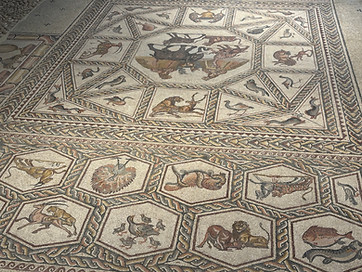
The world of animals

The world of the air and the world of the sea
A walk in the neighborhood including the Church of Saint George and the shuk
There are some interesting things to see in the close neighborhood, including the Church of Saint George and the shuk. You can obtain a free map from the museum desk.
The Church of Saint George is on Eliyahu Golomb St. (enter Church of St George into Google Maps). Adjacent to it is the Great Mosque of Lod. As the city likes to point out, Sharei Shomayim Synagogue is also close by.
Saint George is one of the most revered saints in Christianity. He is the patron saint of England. He was born in this area and buried here. This church is one of the major shrines dedicated to him in the world.
Saint George was a soldier in the Roman army. When the emperor Diocletian issued an edict persecuting Christians, Saint George publicly denounced the edict and proclaimed his Christian faith.
Somewhere in the story he encountered a dragon that was threatening the city. The inhabitants appeased the dragon by offering it sheep, but when the sheep ran out, the dragon demanded a human sacrifice and the lot fell upon the king’s daughter. Saint George confronted the dragon and slew it. The city was so inspired by this act that they converted to Christianity. Despite this, Saint George was martyred for his Christian faith for refusing to renounce Christianity during Diocletian’s persecution. This legend became very popular in Europe during the medieval period and continues to symbolize the triumph of good over evil.
This church is a Greek Orthodox church, and you may not be familiar with this type of church. It was built on a partially reconstructed Crusader-period church, which in turn was built on a Byzantine period church. It has a basilica style, except that the aisle on the right is missing. This is because it was taken down and the area used for the Great Mosque of Lod.
Unlike in a Catholic church, the altar is hidden by a partition, which is richly decorated with icons. St. George is the second icon on the left from the door to the altar. In a box are relics of a few bones of St. George. In a corner, is the chain with which St. George was bound. Within the crypt below, which can be visited via the stairs, is the sarcophagus that is venerated as the tomb of Saint George.
Before you leave, look at the door of the church. The main symbols you see are the Taufos (Tau-Pi) Emblem, which in Greek means "tomb" and identifies the Greek Orthodox brotherhood of monks who guard this Holy Site and other Greek Orthodox assets in Israel. The Cross in Orthodox Christianity represents Christ’s victory over death and evil. It also marks the church as sacred space. The words “IC XC NIKA” mean IC = Jesus, XC = Christ and NIKA = conquers/victorious. So, the inscription proclaims Christ’s triumph over sin, evil, and death.
Above the doors is a relief showing Saint George on horseback defeating the dragon. This is the best-known image associated with him. In Christian symbolism the dragon represents evil, chaos, paganism, or Satan, Saint George represents faithful courage and Christian victory, and the rescued princess symbolizes innocent people saved from evil. The image became one of the most widespread Christian symbols in the medieval world and is especially important in the Eastern Orthodox tradition.
According to a notice on the church, the church is open Tuesday 12.00 p.m. to 1.00 p.m., Thursday 10.00 a.m. to 1.00 p.m., Friday 12.00 p.m. to 4.00 p.m., Saturday 9.00 a.m. to 1.00 p.m. and Sunday 9.00 a.m. to 1.00 p.m. It is closed on Monday and Wednesday.


Look at the symbols on the door of the church
The shuk is off Avishai Elashville St. and is visited by thousands of people from in and around the city. On Monday are sold vegetables and fruits. On Tuesday there joins them sellers of household goods, cloths, Judaica etc.

The Jindas Bridge
On the outskirts of Lod is a Mamluk bridge called Jisr Jindas (also spelled Jindas Bridge or Baybars Bridge). It is one of the best-preserved medieval bridges in Israel and one of the most important surviving structures from the Mamluk period. It was built in 1273 CE during the rule of the Sultan Baybars.
There is scholarly debate about whether the bridge reused older Crusader or even Roman stones in that some Crusader-style masonry and carved crosses appear in parts of the structure, leading some historians to think the Mamluks rebuilt an earlier crossing. Others believe Baybars’ builders reused stones taken from destroyed Crusader buildings, possibly even from the Church of Saint George in Lod.
The bridge stands on the northern edge of Lod, crossing the upper channel of the Ayalon River and near the old road between Lod and Ramla. Today it carries part of modern Route 434. It was strategically placed at an important crossing point on the north–south road linking Egypt and Syria and near the east–west route from Jaffa toward Jerusalem. Because Lod sat at the junction of major trade and military roads, the bridges here were important for the movement of armies, caravans, and postal routes.
The bridge is built from large dressed limestone blocks and still carries traffic today. It is supported by three arches, with the central arch larger than the others. Its most famous features are the carved stone reliefs and inscriptions on both sides that include carved lions or panthers. which were the royal emblem of the Mamluk Sultan Baybars. In some carvings the animal appears to play with or dominate a small rodent-like creature, symbolizing victory over his enemies.
The bridge can be viewed from a small park by the side of Derech Yitzhak Shamir. Enter “Baybars Bridge” into Waze. Look for the stream.

Baybars Bridge

The inscription and feline symbol on Barbars Bridge