The Agam Museum of Art in Rishon LeZion
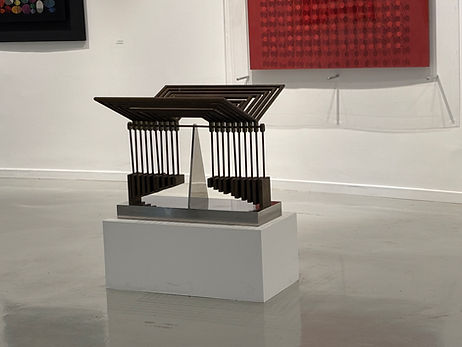
The Agam Museum of Art in Rishon LeZion showcases the lifelong work of the famous Israeli artist Yaacov Agam, and is a center for the display of his kinetic and optical art. Agam was born in Rishon LeZion, and the museum is supported by the municipality. The museum advises viewing the museum with a guide, and I would strongly agree with this. Unlike other art museums which display paintings, this museum is about art in relation to movement — your movement and sometimes the art piece itself. The latter, in particular, can only happen with a guide since there are no buttons to press. Even how to view the artwork and appreciating the meaning of the piece benefits from explanation.
A daily tour is usually offered in Hebrew for a small additional charge, and a tour in English can be pre-arranged in English with a group of 10 or more.
The exhibits are on two levels, with a ramp leading to the upper level. The upper level contains information about Agam’s professional life, while the lower flour displays his art work.
There is a nice garden adjoining the museum which has a children’s play area and picnic benches, although none are in shade. There are also other benches in the garden, some of which are in shade. There is a kosher Aroma restaurant across the road, which is only a short distance away from the museum.
The two Israel travel books that everyone was waiting for!
Bestseller! "In and Around Jerusalem for Everyone - The Best Walks, Hikes and Outdoor Pools" and new! "The North of Israel for Everyone. The Best Family Activities, Hikes and Historic Sites" by Arnold Slyper — with essays, directions, maps, and much more.
For courier service from Pomeranz Booksellers in Jerusalem (tel: 02-623 5559) click here and here. For Amazon click here and here. For details about the books and their outstanding reviews click here and here.
What is unique about Yaacov Agam and his art?
This is not given a lot of emphasis in the museum, but it is helpful to view Agam’s lifework from the perspective of his religious background. He was born in 1928. His father was a rabbi and kabbalist. Agam spent the first years of his life at a cheder before going to a gymnasium at age 13. He studied art at the Bezalel Academy of Arts and Design in Jerusalem, then went to Switzerland to study modern art, and finally moved to Paris in the 1950s. He remained in Paris, although he maintained close connections with Israel.
Agam decided early in his professional life that he would not paint human figures or animals. This is not halachically forbidden, but especially in a place like Paris, where painting nudes was common place, the direction he chose for himself would have defined his place in the artistic world. It also led to a focus on geometric shapes and how to maximize their artistic value. Agam did not invent kinetic art but he was a pioneer in its use.
Kinetic art is a form of art that incorporates movement as a fundamental element of its design. Some kinetic artworks physically move, and there are examples of this in this museum, while his other works do not move but create the illusion of motion through shifting patterns, colors, and light effects. Many kinetic artworks change depending on the viewer’s position or movement, thereby engaging the audience in an active experience. Agam was a pioneer in this type of polymorphic art. It is suggested that he may have conceptualized this art form when viewing the shifting sand dunes around early Rishon LeZion.
When viewing the polymorphic art in the museum do not rush the experience by jumping from one end of the picture to the other, as I did before the guide explained that one should view the picture slowly appreciating the change in the forms of the geometric patterns and the change in color from softer (more female) colors to darker (male) colors. Agam also developed a unique technique of lenticular prints or Agamographs, in which the images are printed on a series of ridged surfaces, allowing different images to be seen from different angles. Some of his abstract art is based on religious and kabbalistic imagery.
Yaacov Agam has described what he was attempting to do in his early years: "[My works] reflect my efforts to reach beyond the boundaries of artistic expression. I aspired to create a type of painting that exists in both space and time, where it can develop and change. My goal was to produce infinite plastic situations that emerge from one another, with their continuous appearance and disappearance offering constant discovery and renewal."
Agam did not return to Israel after his initial training. One might speculate that he would not have received the international recognition he achieved working outside the center of modern art in Europe.
His works have been exhibited in prestigious museums and galleries including the Musée National d’Art Moderne in Paris, the Guggenheim Museum in New York, the Museum of Modern Art in New York, and the Tel Aviv Museum of Art in Tel Aviv. Awards and honors he has received are the Prix de la Critique in Paris in 1953 in recognition of his innovative contributions to kinetic art, the Chevalier of the Legion of Honor in France in 1974 for his contributions to art, this being one of France’s highest civilian honors, and the Jan Amos Comenius Medal awarded by UNESCO in 1996 for his contributions to art education and his cultural impact.
His public art installations include the "The Agam Fountain," a large-scale kinetic fountain in the business district of Paris, “The Panoramic Frieze" commissioned by French President Georges Pompidou for the presidential Elysée Palace in Paris, his "Peace Monument" in Chicago, a symbolic sculpture reflecting his themes of movement and harmony, and the "Gates of Faith" in Los Angeles, a major sculpture representing Jewish spiritual themes.



These impressive pillars were also designed by Agam

Nearby places of interest:
The Rishon LeZion Museum in Rishon LeZion. See our website
Superland amusement park has a number of roller coasters.
Hai Kef Zoo is a small zoo in Rishon LeZion. Some reviews find it upsetting that the animals are in cages rather than there being an attempt to imitate their natural environment. Not a zoo to visit from afar, but a pleasant place to visit if you are already in town.
Palmachim Beach National Park is worth visiting. See the webpage “The gorgeous beach at Palmachim Beach National Park.” In addition to stunning views, there is history to see, as the National Park houses the remains of the Yavne-Yum, an ancient port city dating from the Middle Bronze Age.