The Yemenite Heritage Center and Machon Ayalon in Rehovot
The Yemenite Heritage Center
The aim of this interesting museum is the study and preservation of the unique heritage of Yemenite Jewry.
A fascinating and enlightening movie is shown in the auditorium about the origins and immigrations of the Yemenite community to Israel and there are photographs, displays of clothing and art treasure of their jewelry.
Directions: Enter “Yemenite Heritage Center” and click on The Yemenite Heritage Center, Abarbanel Street, Rehovot.”
Admission: Hours are 9.00 to 5.00 pm Sunday to Thursday, Tuesday 9.00 to 1.00 pm and 4.00 to 7.00 pm. It is closed on Friday and Shabbat. Admission is 30 NIS, 25 NIS for seniors and 10 NIS for children. A tour can be arranged for a minimum of 20 people, and can also be in English. There is a cafeteria. Their phone number is 073 394 6150.
Public transport: Enter “Yemenite Heritage Center” into Moovit. There are adequate buses to and from the Rehovot bus station.

The two Israel travel books that everyone was waiting for!
Bestseller! "In and Around Jerusalem for Everyone - The Best Walks, Hikes and Outdoor Pools" and new! "The North of Israel for Everyone. The Best Family Activities, Hikes and Historic Sites" by Arnold Slyper — with essays, directions, maps, and much more.
For courier service from Pomeranz Booksellers in Jerusalem (tel: 02-623 5559) click here and here. For Amazon click here and here. For details about the books and their outstanding reviews click here and here.
The travails of the Yemenite Jews in Israel
There was individual Jewish immigration from Yemen for many years, but the first organized wave was in 1881 with the immigration of 200 Yemenite Jews. By 1915 about 10% of the community had left for Palestine. A major airlift beginning in 1949, Operation Magic Carpet, brought 50,000 Yemenite Jews to Israel, which was almost the entire remaining Jewish community.
The movie shown does mention that the Yemenite immigrants experienced difficulties during their immigrations, but does not elaborate on this, although they can certainly be discussed during group tours. However, without discussion of the absorption issues faced by the immigrants the story of their immigration is only half complete.
For example, when the Yemenite Jews arrived in Jerusalem in the 1880s, they were not welcomed into the Old City and were forced to live in caves in the nearby village of Silwan. They were finally supported by evangelical Christians who appreciated the messianic implications of this Yemenite immigration. If one wishes to be generous, one could say that the Jews of the Old City could not place these simple, impoverished Jews with different customs and who looked more like Arabs than Europeans into their image of what Jews should be like. If one did not wish to be so generous one could say that the Jews of the Old City were not willing to share their limited resources and charitable contributions with these newcomers.
During the 1900s, they were also often treated poorly. A group living in the moshava Degania Aleph, for example, helped clear the swamps, often with their lives and that of their children from malaria. Yet after many years they were told to leave. The generous explanation is that they were not felt to be suitable material for kibbutz life. A less generous explanation is that they were exploited.
Upon their arrival in Israel may Yemenite immigrants were placed in temporary transit camps, which were often overcrowded and lacking in basic amenities. Many were settled in underdeveloped areas or in poorer neighborhoods, which contributed to their socioeconomic challenges. An issue still discussed without resolution is the allegation that Yemenite children were taken from transit camps and hospitals and put up for adoption by Ashkenazi families without the parents’ permission. They often had difficulty in obtaining quality education. The different customs and culture and their language difficulties made it difficult for Yemenite Jews to integrate smoothly into Israeli society. They also arrived in Israel at a time of limited resources and Ashkenazi Jews controlled these resources.
On the other hand, these are generalizations and many Yemenites were able to integrate very successfully and make significant contributions to Israeli society. In recent years there have been efforts to address these historical injustices and to promote a greater awareness of Mizrahi Jewish culture. This museum is but one example.
This predominantly religious community also had tremendous faith and internal resources that helped them overcome their difficulties. They believed that the airplanes that came to collect them after the pogroms in Yemen following the 1948 War of Independence were truly the “eagles wings” of redemption. This biblical phrase (Exodus 19:4) signifies the miraculous deliverance from Egypt experienced by the Jewish people and the providence and close relationship God has with His nation.

Yemenite clothing exhibit

Scene from the movie shown.
Machon Ayalon (Ayalon Institute)
Machon Ayalon is a National Heritage Site in Rehovot, and was the site of a clandestine bullet manufacturing factory for over two years prior to the 1948 War of Independence. It produced 9 mm bullets for the British-designed Sten machine gun, which was also manufactured by the Jews. It is worth noting that the War of Independence did not happen without preparation. The Yishuv was preparing for independence well before 1948, and was building the military, industrial and organizational infrastructure necessary for statehood. This site was part of the Haganah’s secret arms industry. This particular project entailed considerable ingenuity and personal sacrifice, both of which are emphasized during a tour of the facility.
Directions: Enter “Ayalon Institute” into Waze.
Admission: The institute is open from Sunday to Thursday from 8.30 AM or 9.00 AM to 4.00 PM, with the last tour at 3.00 PM. On Friday from 9.00 AM to 2.00 PM, with the last tour at 1.00 PM. The price of admission for individuals is adults 33 ₪, children 24 ₪, and seniors and students 24 ₪. Visits are only within the context of a tour, which can be in English, and this needs to be prearranged. Individuals can be linked up with a group. A movie is shown during the tour. There are inside and outside restroom facilities. There are shaded picnic benches. Their telephone phone number is 08 940 6552. This is their website.
Public transport: Enter “Ayalon Institute” into Moovit. The bus stop is only a few minutes from the museum.
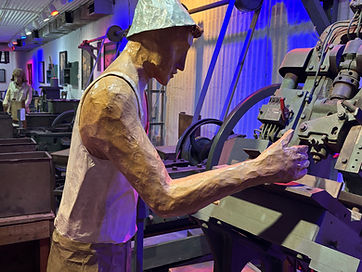
45 young men and women worked in the factory
As the years progressed, the British became more and more disillusioned with the notion of Jewish homeland, despite the Balfour declaration, and under Arab pressure they severely restricted Jewish immigration and the acquisition and manufacture of weapons. It was therefore essential that this factory not be discovered by the British. This concrete factory was built eight meters below ground and its relatively isolated position helped maintain secrecy.
Established in 1932, “Kibbutzim Hill” was a center for the training of Jewish pioneer groups for kibbutz life. The workers for this factory were predominantly scouts (Tzofim Aleph) who had intended making preparations for setting up a kibbutz. Nevertheless, they readily agreed to participate in this project, even without being told the details of what the project was all about. It turned out to involve considerable self-sacrifice. It was potentially dangerous, especially If discovered by the British. The 45 workers needed to work underground on long, noisy shifts, and had to maintain absolute secrecy.
On your tour, you will visit the two above-ground buildings that hid the activities of the factory. One was a commercial laundry. The entrance to the factory was beneath the laundry machine and its noise helped muffle the noise of the factory. Work was sought for the kibbutz laundry business to keep the laundry machinery legitimately functioning for long hours. This included a maternity hospital and the British army! The machinery was purchased a few years before in Poland and was smuggled into Palestine via Beirut.
Yours and the workers entrance/exit from the factory was via a bakery. The bakery provided ventilation for the factory and also made noise. Factory machinery and raw materials could be brought to the factory beneath the oven. The electricity used was stolen. The workers received insufficient sunlight and were given artificial tanning treatments with ultraviolet light.
A conservative estimate is that the factory produced some 2.25 million bullets during its operation. After the war, it was moved to Tel Aviv. The site became incorporated into the Weizmann Institute. The young pioneers who worked in the factory eventually realized their dream of establishing a kibbutz and moved to the coastal area south of Haifa and established Kibbutz Ma’agan Michael. In 1987, Machon Ayalon was declared a national heritage site and was opened as a museum.

Visiting the laundry

In the bakery
Other nearby places of interest:
See The Weizmann House in the Weizmann Institute of Science